
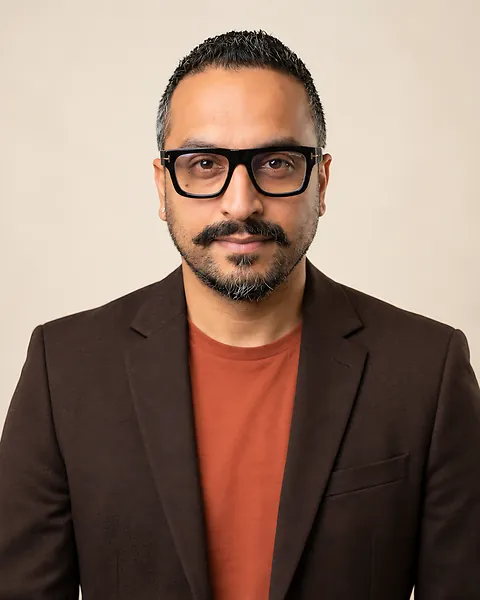
I am an early childhood teacher and leader in Auckland, a father of two, and the author of Making Sense of the First Five Years. I write about what young children are actually doing, why they do it, and how they learn.
From primary school to under-twos
I did not set out to work with very young children. I trained as a primary teacher overseas, and I was good at it in the way you are good at something you have been taught to do properly. I could plan a unit. I could hold a room of thirty. The curriculum had a beginning and an end, and I always knew where we were in it.
Then I moved to New Zealand, decided to study further, and chose early childhood education. I could not have told you exactly why at the time.
That is where my real training started. Not with the qualification I already had, but in a room in Auckland with a dozen two-year-olds in it, where almost nothing I knew about teaching was any use. You cannot plan a lesson for a two-year-old. Nobody sits down. The curriculum is being written in real time by somebody who is currently emptying a shelf onto the floor for reasons of his own, and your job is to work out what he is doing and why. It took me the better part of a year to stop trying to teach and start trying to watch. Almost everything I am any good at, I learned in that room.
I now have more than a decade of experience working with young children and their families: babies, toddlers and preschoolers, the parents who bring them through the gate each morning, and the teachers I have worked alongside and led. Te Whāriki, our early childhood curriculum, shapes how I think about all of it.
Then I became a father
My son was born in December 2018. Six days later I was sitting on a bathroom floor at three in the morning with a baby who would not stop crying, looking up an article I had once recommended to other parents.
I had been the person friends rang when their baby would not sleep or their toddler started biting. I had the information. What I discovered that week is that information and understanding are different things. Knowledge tells you what children do. Understanding tells you what this child is doing, right now, in your kitchen.
His first few years were not the ones we planned. He was fifteen months old when New Zealand went into its first lockdown, and much of the stretch between then and his third birthday happened in a very small world. He was slow to talk. He cried at the gate for weeks. At a new kindy, he stood at the edge of the sandpit and watched for eleven days before he joined in. I am a professional, and I still did a lot of anxious arithmetic at three in the morning.
We now have a daughter as well, who is a completely different person, which has taught me its own lessons.
Why I wrote the book
Making Sense of the First Five Years is the book I wanted on that bathroom floor. It follows one ordinary boy from birth to school and uses everyday moments, the dropped spoons, the supermarket meltdown, the sandpit, the endless questions, as a way into the science of what young children are doing. It brings together three things I care about: what I have learned in early childhood rooms, what I have learned as a father, and what research can and cannot tell us.
It is not a method or a philosophy. It is about learning to read a child, and it includes plenty of moments where I got that badly wrong.
What I write about here
In Insights I write about how young children develop, learn, play and relate to other people, about behaviour and what it might be communicating, and about being a parent, and particularly a father, in the early years. I write for parents and whānau, and for my fellow kaiako and educators.
I try to be honest about evidence. Where research is clear, I say so and link to it. Where it is contested, I say that too. Where something is my own observation from the classroom rather than a finding, I label it as one.
I am a teacher, not a doctor or a psychologist, and nothing I write is medical advice or a diagnosis. If something about your child worries you, please talk to your doctor, a child health nurse or your child's teachers, who know your child in a way I cannot.
I live in Auckland with my family. If you would like to get in touch, you can find me on the contact page.